How to Get LLMs to Mention Your Brand
Simply appearing on a search page isn’t enough anymore, not in today’s world driven by…

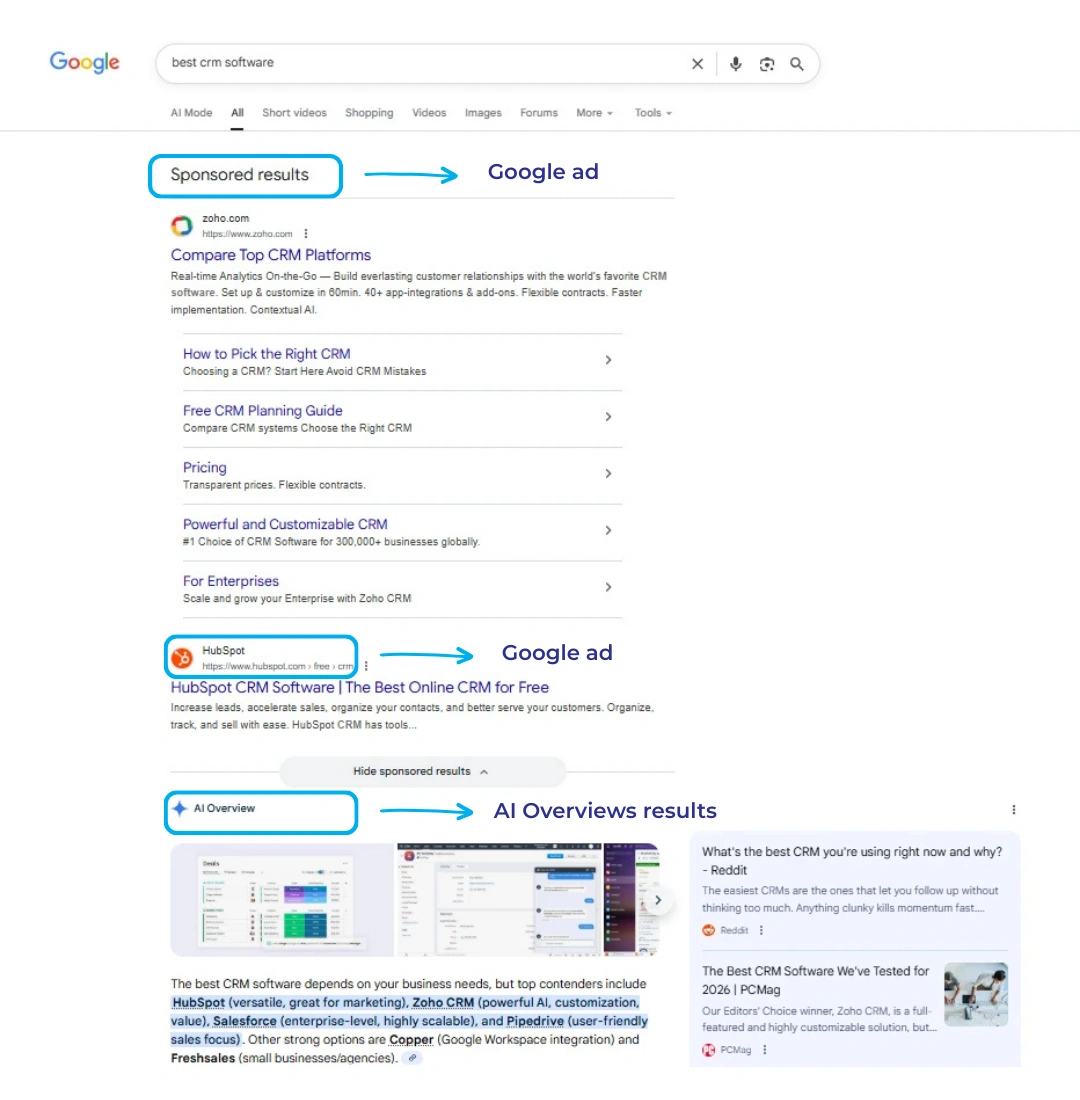
There’s no denying that Google’s AI Overviews changed the face of search seemingly overnight. After all, AI search results are now displayed at the top of results, making it easier for users to get the answers they need without even clicking on a ranking webpage or an ad. Previously, businesses relied on paid and organic methods to drive traffic and conversions their way. Search engine results pages (SERPs) are shifting into something that’s all about making sure the user has the best experience finding the information they need quickly. These SERP changes mean Google ads aren’t always shown at the top of search results anymore, where AI Overviews are applicable, which is a big challenge for brand visibility.
However, this doesn’t mean that Google Ads are dead in the water. In fact, the popularity of the generative search experience that AI Overviews provide means that the search engine giant is now showing ads within overviews results in some countries, but this hasn’t arrived in the UK just yet… Ads still show prominently for queries that don’t garner AI summaries and appear lower down the page in search results that do, so they still have the power to influence users, not to mention they’re an essential moneymaker for Google.
Our latest blog unpicks everything you need to know about Google Ads in the AI Overviews era. Read on to learn everything you need to know!
How AI Overviews Change the Search Landscape
AI search results have shaken up how search is done. Increasingly, users want answers to their queries fast without clicking on any organic results or PPC (pay-per-click) ads. AI Overviews are now dominating results, meaning users can get the answers they want with no hassle.
These SERP changes have had a significant impact on paid search. The user journey has obviously changed. Thanks to AI Overviews and LLM search engines like ChatGPT, users no longer need to do multiple searches to find the information they need. The result? Fewer high-intent searches, which previously were the bread and butter for PPC ads to appear for.
This type of generative search experience has also pushed paid results down the page; they have lost some visibility, which has lowered the click-through rate (CTR). A recent study showed that where AI Overviews appear for informational queries, paid CTRs drop from 19.7% to just 6.34%. Despite all this, paid ads are still relevant and, when implemented correctly, can help build a brand’s awareness and influence a user’s decision, eventually leading to conversions.
Where Google Ads Still Drive Value
Yes, AI Overviews are now taking up a lot of the space where paid search once reigned, but that doesn’t mean that ads aren’t still important. Google ads are still vital for high-intent searches. When users search with strong buying signals about costs, specific brands, or local shops, the user intent is obvious.
This is where a well-executed paid search strategy that is designed to appear at crucial decision moments for users is vital: it keeps brands visible when it matters the most by targeting conversion-focused search keywords.
Concentrating on your Google Ads performance alongside organic and AI-driven search results helps to build the authority and awareness surrounding your brand, even when AI is taking up more space. When you grow your authority and awareness, users are more likely to click on your ad, organic rankings, or summary in AI results. This equals better CTRs and conversions. It’s a win-win all around.
The Role of Data and Reporting in Paid Search
Analysing your advertising performance data is still crucial for the success of your paid search campaigns. Even when AI is heavily influencing the search world. Looking at metrics is the only way to truly understand how your campaigns are performing, pinpoint areas for improvement, and make decisions that drive results as you move forward.
Carrying out a regular PPC performance audit and using the right PPC reporting tools that can process large amounts of data can help you to easily spot trends of the things that are working and those that aren’t. This type of campaign analysis will allow you to:
Looking at your performance insights closely means you can make the most of your return on investment (ROI)The ROI is the ratio of the return from an investment to the cost of the investment., narrow down your approach, and stay in control of your visibility.
How Advertisers Are Adapting in the AI Era
The rise of AI Overviews means that paid search marketers are having to think differently about how they do ads. To stay successful, you need an adaptive strategy, and paid search optimisation now needs to focus on:
All of these are things that our Google Ads services can help you with.
Conclusion: Paid Search Still Has a Clear Role
Digital marketing strategies these days are all about balance to reflect the increasingly changing search ecosystem. You need to combine traditional, paid, and AI search optimisation in your wider digital marketing strategy to stay ahead. That means that paid search’s future is safe for now, especially when it comes to capturing high-intent searches that convert.
Need help refining your Google Ads strategy? Book a call with our friendly team of paid search consultancy experts and let us help you to future-proof your long-term performance.

Simply appearing on a search page isn’t enough anymore, not in today’s world driven by…
Follow vs nofollow links have been debated in digital marketing for years. Questions are often…

Ah, 2021 – the year of volatile Google algorithm updates that shook marketers from within and left website owners scratching…
Ever wondered why certain websites appear at the top of Google’s results page when you search for something? That’s no…

In 2026, digital PR services are essential for any brand wanting to build lasting authority…
Simply appearing on a search page isn’t enough anymore, not in today’s world driven by…
Follow vs nofollow links have been debated in digital marketing for years. Questions are often…
Citations are a long-standing SEO trust signal that helps increase visibility in local search results…
Picture this: you're working at an SEO agency, managing multiple clients and delivering strong results…
You may have heard that Google has rolled out a notable new update: the February…
Search is evolving quickly. Large Language Models (LLMs) and Google AI overviews now have a…
Automation is on the rise in just about every industry, and SEO is no exception…
Fill out the contact form or give us a call for a free consultation to determine the right digital marketing solutions for the growth of your business.

The team will usually respond within 1 hour.