3 Reasons to Use Press Release Distribution for SEO and AI Search Visibility
PR has long supported brands in building authority and spreading awareness, but PR distribution has…

Search engines aren’t the only automated systems accessing, interpreting, and making sense of content found online. AI agents are introducing another possibility: systems that can potentially research information, navigate websites, and also take actions on behalf of users.
For businesses, this creates an important question:
What happens when the visitor trying to understand your services or navigate your website isn’t a person, but an AI system acting for one?
This is exactly where AI agent optimisation becomes important. At Click Intelligence, we see this as part of the wider changes in search and AI visibility. Preparing websites for AI agents is about considering whether automated systems can access your information and understand what it means.
As agentic AI develops, these considerations could become increasingly necessary to how websites are structured and experienced by all users.
AI agents are systems designed to perform tasks on behalf of users, which can include researching information, navigating websites, and interacting with online services. However, they are different from some of the automated technologies we’re already familiar with in search.
A traditional crawler, for example, primarily retrieves information from webpages so that it can be processed or indexed. An AI search system can then use this information to generate an answer to a user’s query. AI agents can potentially go further than this, completing several steps towards a particular goal.
Imagine somebody is planning a holiday. An AI search agent might help research suitable hotels. A more advanced agent could potentially navigate travel websites, compare different options, check availability, and assist with parts of the booking process.
This is the most important distinction when considering AI agents and websites. The question is no longer necessarily just whether an automated system can find a page. Increasingly, we also need to consider what that system can understand and potentially do once it gets there.
Some systems use AI crawlers, while others may rely on search indexes, browser-based technologies, or other methods of retrieving information. Access can also be influenced by robots.txt rules, JavaScriptJavascript is one of the web’s key programming languages but coding it incorrectly can cost you in technical SEO terms. In order to avoid common mistakes, and understand how Java operates, here’s a quick guide to coding Java the right way. implementation, authentication requirements, and bot controls.
This means that AI website accessibility is more nuanced than just allowing or blocking a crawler.
Google, for example, explains that many of the established fundamentals of SEO continue to apply to its AI search experiences. Different automated systems may encounter and process the same website in different ways, but the clarity and accessibility of the information they encounter still matter.
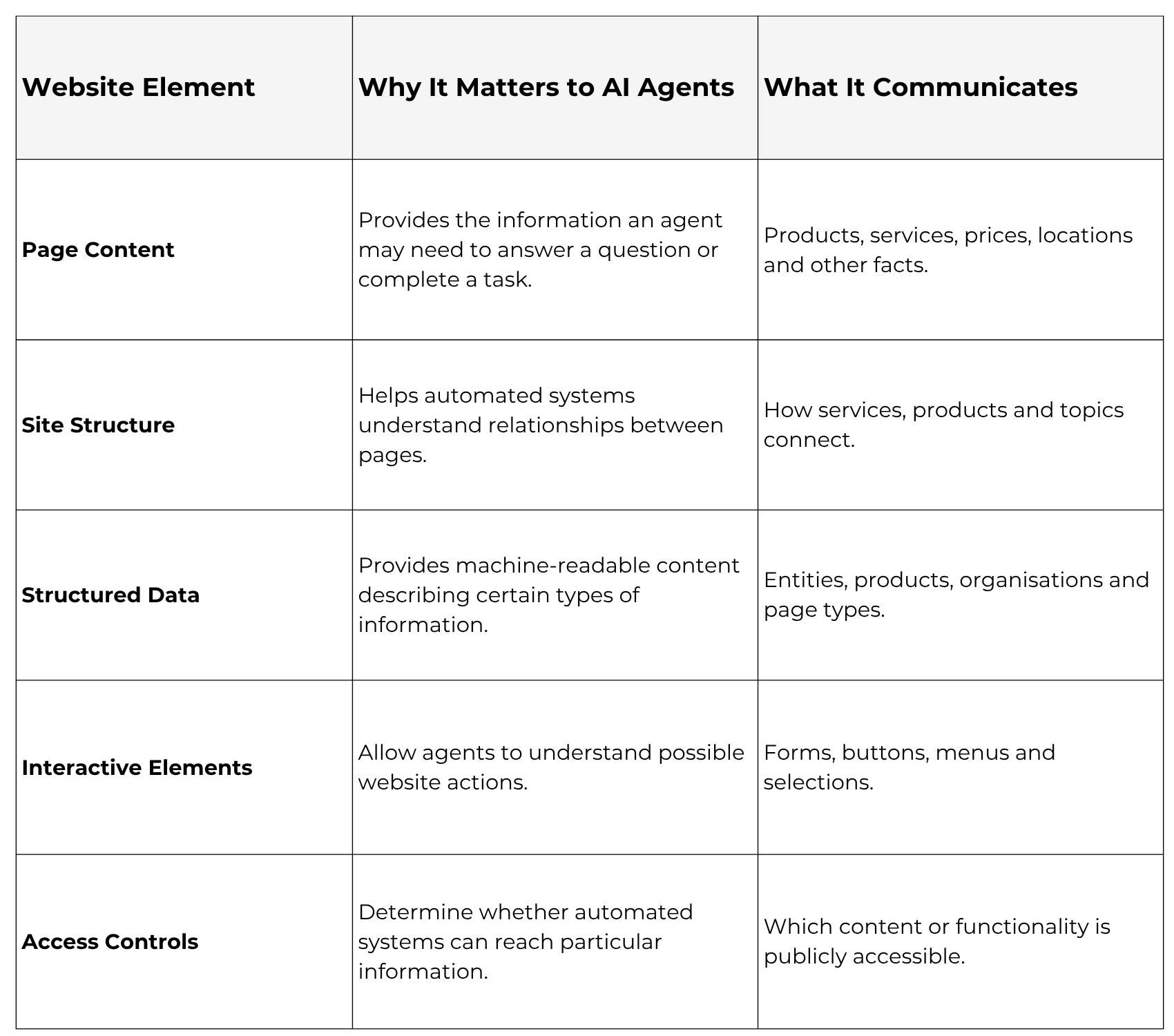
AI-agent readiness involves both the information a website provides and the way that information and functionality are presented to automated systems.
This is why we see strong SEO foundations continuing to play an important role. With our Managed SEO services, we already focus on areas such as crawlability, internal linking, content quality, and technical performance.
An AI agent may need to understand both the information presented on a website and the purpose of interactive elements such as forms, buttons, and menus. Clear website structure can make the purpose of a page and its individual elements easier to interpret. Consistent terminology matters as well. If the same service is described in conflicting ways across different areas of a website, the relationships between those pages may be less clear. When implemented appropriately, structured data can provide explicit, machine-readable descriptions of particular entities and content types. This can complement the information already visible on the page.
Together, these signals can help communicate relationships such as:
Brand→ people→ services→ products→ locations→ expertise
This is part of our AI SEO services and Content Optimisation work. Content still needs to serve the person reading it, but businesses also need to consider how clearly their online information communicates meaning and context to the systems processing it.
The information available away from your own website can contribute to that wider picture too. Through Digital PR services, for example, businesses can earn relevant coverage and mentions across third-party publications.
That doesn’t guarantee an AI platform will surface or recommend a business, though. However, it does demonstrate why AI search visibility isn’t necessarily confined to what exists on your own domain.
AI agent browsing introduces something that traditional crawling doesn’t need to address, which is understanding and potentially interacting with interfaces. Websites contain far more than written content. It might also include navigation menus, buttons, filters, search functions, enquiry forms, booking platforms, and shopping baskets, etc.
If an agent is attempting to complete a multi-stage task, it may need to identify what these components represent and understand what happens when they’re used.
This is where semantic HTML, web accessibility, and accessibility information such as ARIA can become relevant. Semantic HTML provides meaning as well as presentation. ARIA can provide additional information about the roles, properties, and states of interface elements, particularly where native HTML alone doesn’t provide the required accessibility information.
As examples, for an e-commerce business, an agent for AI website interaction could potentially find products and compare specifications. On a travel website, it might navigate dates and check availability. These show the potential agent behaviour rather than guarantees. The capabilities of autonomous AI agents vary, and individual websites can also restrict the information and functions that automated systems are permitted to access.
Preparing for AI agents is likely to involve considering how clearly a website communicates its information, structure, and available actions to automated systems. Historically, businesses have largely designed websites around two audiences:
Humans + search engines
The growth of agentic AI could introduce a third:
Humans + search engines + AI systems capable of taking action
AI-ready websites open the conversation about what makes information accessible and understandable online, from clear site structure, structured data, and website interfaces to security and authentication. Different platforms can access, interpret, and interact with websites in different ways, and today’s understanding of AI agent optimisation is likely to evolve as browser agents, protocols, and standards develop.
First, an automated system needs access to useful information. It then needs sufficient context to understand that information. From there, more advanced systems may be able to navigate between pages and, where appropriate and permitted, interact with website functions.
At Click Intelligence, our AI SEO services are built around this broader evolution. As the relationships between search engines, AI systems, and websites change, we’re focused on helping businesses understand how discoverability and AI website visibility are changing without losing sight of the SEO foundations that continue to matter.
The web was originally built for people to browse. Search engines encouraged businesses to think about how machines read it. Advanced AI agents could make the next question equally important: What happens when machines start using it?

PR has long supported brands in building authority and spreading awareness, but PR distribution has…

AI has become part of how people research and look for products, as well as…
Budgeting for SEO is a terrifying prospect. There are so many elements in play, and seemingly endless considerations, rendering it…
Are you struggling to think about what to write about for your content marketing efforts? It’s not an uncommon situation–particularly…

The amount you invest in your link building budget should be based on the realistic…
Search engines aren't the only automated systems accessing, interpreting, and making sense of content found…
There's plenty of scope when creating SEO campaigns. Each industry that turns to experts for…
PR has long supported brands in building authority and spreading awareness, but PR distribution has…

SEO can be complicated. It’s constantly changing and is not a one-and-done job. That’s something…
Google announced it was rolling out a further spam update on August 18, 2026. It…
Growing an SEO agency takes a lot of hard work. You've got to keep up…
AI has become part of how people research and look for products, as well as…
Fill out the contact form or give us a call for a free consultation to determine the right digital marketing solutions for the growth of your business.

The team will usually respond within 1 hour.