
How to Budget for Link Building in Your SEO Strategy
The amount you invest in your link building budget should be based on the realistic…


There’s plenty of scope when creating SEO campaigns. Each industry that turns to experts for digital marketing for search and AI visibility will find itself with a tailored campaign that is perfectly suited to its industry. For most standard markets, these can include generic but reliable techniques, modified for each client. However, for those of them that find themselves in niche markets, like iGaming, adult, crypto, NFT, CBD, and Vape, this is where things start to get a little murkier.
How experts handle SEO for specialist markets is significantly different from those who find themselves in the travel industry, for example. Your market may be highly regulated, extremely competitive, and technically complex, making it more difficult to build linksHyperlinks, also known as links, are the connection points on a webpage that take you to other webpages. within it, dependent on expert content, and commercially valuable despite limited search demand.
If you are in one such industry yourself, are thinking of starting a business in one, or you are struggling with creating your own specialist SEO strategy, our guide is here to help you.
While there may be less stigma these days, specialist SEO markets often have complex products or services suitable for one very specific demographic, with many viewing them as high-risk, high-reward. For this reason, SEO for specialist markets requires a strategy built around the search behaviour, competition, terminology, authority requirements, and commercial realities of a specific industry.
SEO strategy services enable them to handle the significant search demand, high CPCs, and aggressive SERPs many of these specialist markets have, while bearing in mind regulations and the highly informed audiences that come with it. There is often specialist terminology required, different conversionA conversion is a desirable result on a website that leads to an action such as completing an order, filling out a form, or simply clicking on a link. economics, restricted publisher ecosystems, and strong incumbent domains to consider.
The first step in putting together SEO for specialist markets is keyword researchKeyword research helps websites unearth the best keywords to drive traffic and visibility. This research is supported by a number of powerful web-based tools, the best of which we’ve listed here.. Given the type of market you are in, you must analyse this in full. Look into:
Getting your answers to each of these questions gives your campaign a solid foundation, and you can start pulling together a list of keywords.
What sets specialist keywordKeywords are the words and phrases that potential customers might search for to find your business. research apart from the standard is what you do with them after you’ve compiled them. You need to take these and form them into repeatable modifier categories. These are groups of keywords that can be combined to generate long-tail keywordLong-tail keywords are phrases with more than two words. They're also more specific, often using modifiers to narrow down a search. variations.
For example, you might have:
Service + sector =SEO agency for iGaming companies
Product + audience = financial software for wealth managers
Service + specialism = link buildingLink building is a process of acquiring links pointing to your website. These links are obtained by creating content, participating in social media or commenting on other blogs. for crypto websites
Problem + sector = how iGaming companies can improve organic visibility
Service + location = SEO for NFT websites UK
Commercial qualifier + service = best iGaming SEO agency
Where many specialist market SEO campaigns go wrong is when they don’t have the right experts by their side and try to compete across every broad topic within that technically complex or competitive sector. This can spread investment too thinly and bring little to no results. Specialist SEO should group queries according to search intent and SERP behaviour rather than creating separate URLs for every keyword variation. Identifying the specific areas of demand and establishing exceptional topical authority SEO results in a much stronger approach.
Your opportunity lies within satisfying four critical elements at the same time:
If you are able to create SEO topics that people are actually searching for and interested in, that are relevant to your business, offer great value, and can realistically rank for, you have hit the nail on the head. Consider this: a relevant keyword with a high search volume might have the wrong audience searching for it, meaning there is little commercial value in it. Another might have excellent commercial intent, but rankings will be impossible because of the already dominating authoritative sites. Neither option will bring fantastic results.
It’s all about getting the balance just right, ticking off each of those four categories.
Ready to see if you have a good enough opportunity available, take a look at our comparison table.
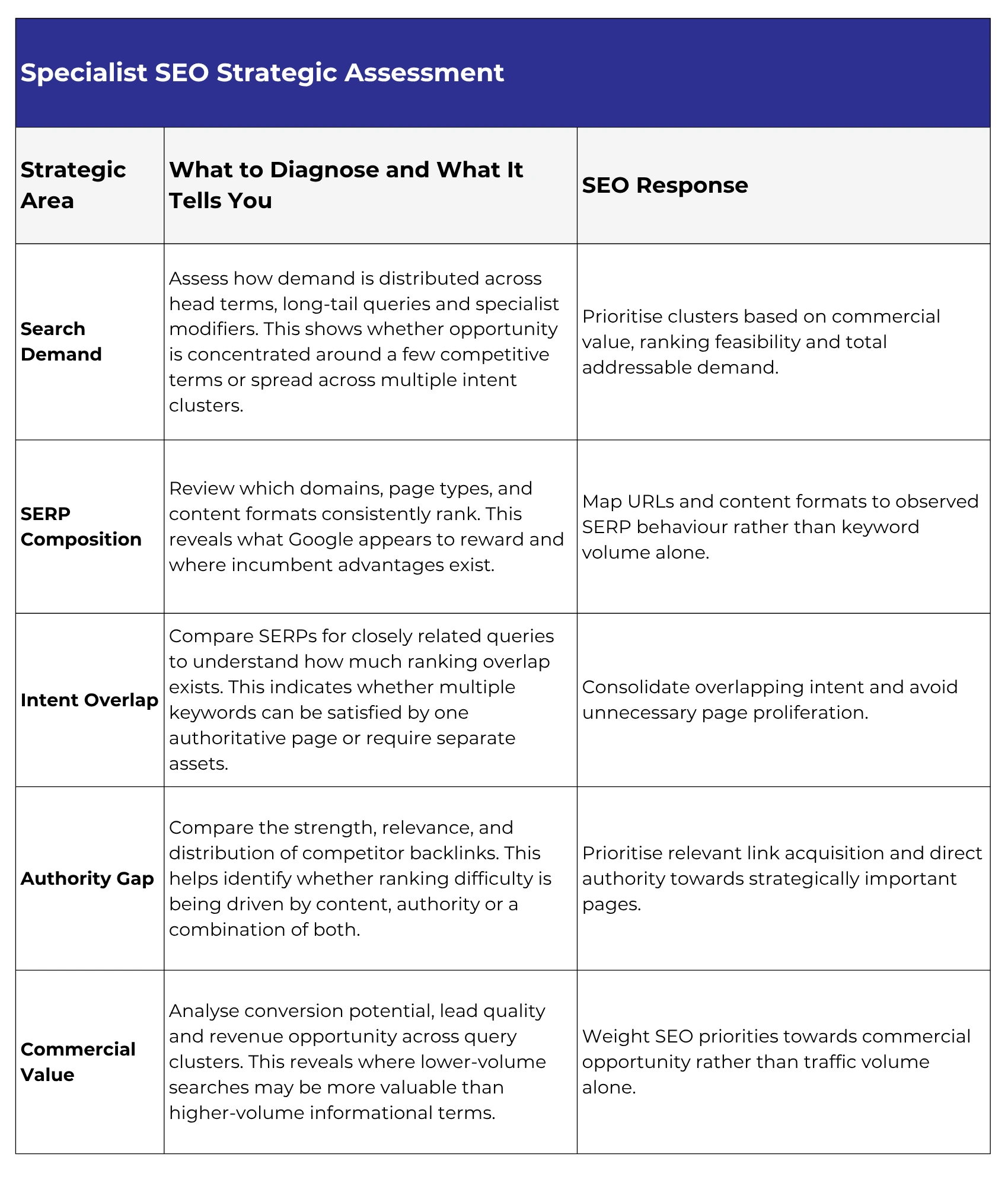
Important: SEO strategy should reflect the technical, editorial, and commercial characteristics of the specialist market rather than applying the same optimisation model across every industry.
With any industry-specific SEO campaign, when granted the opportunity to do so, you should aim to establish deep topical authority. There is a catch. You must demonstrate that you have genuine knowledge of the subject. You can’t be producing broad quantities of generic content, offering nothing of true value to the reader.
As part of your advanced SEO strategy, you must build a deliberate topical architecture around the areas where you have expertise and commercial relevance.
Link building in specialist markets requires greater consideration of publisher relevance, editorial context, industry expertise, and the availability of credible websites within the sector. The reason for this is that relevant publishers may be much smaller, more regulated, and more difficult to access for such markets.
For specialist link building to bring the best results, we always recommend doing a competitor backlink analysis. Such a technique allows you to identify SEO and AI opportunities available to you. While you can do this manually, a much smarter route is to use a tool like Click Insights.
Once a competitor analysis has been completed, the direction your SEO for specialist industries goes is on a case-by-case basis, but it’s not just about getting plentiful backlinks. As you are in such a competitive market, SEO link building is more about helping your company to become a recognisable authority on subject matters that are most relevant to you.
Running digital PR campaigns as part of your specialist market SEO budget enables you to do just that. It can take your stories, reports, commentary, statistics, and so much more, and make journalists and relevant publications actually want to reference you. From this, you can earn links and mentions from credible third-party websites, build on your authority, and improve your rankings.
But it’s not just your rankings; when you are able to gain industry authority, you’re also able to make a positive impact on your AI search. As you start to build a picture of yourself as a specialist, gaining third-party links, you’ll also be strengthening the signals that AI systems look for when sourcing their information. Want to boost your chances even more? Our AI SEO services are available to bring a campaign to life.
No matter what type of link building you try, the ultimate goal for any specialist market is to build up a catalogue of E-E-A-T standard articles both on their own website and off it, while sticking to Google’s link best practices.
One of the biggest hurdles that sector-specific SEO faces is navigating the raw organic trafficOrganic search traffic (sometimes called natural or unpaid search) is the traffic that's driven to a website because of unpaid placement on a search engine results page.. Why? Well, it can be particularly misleading. As a specialist B2B service, you may have a small addressable audience with an extremely high customer value, while another sector, say an iGaming company, can have enormous search volumes but extremely aggressive acquisition costs. As each sector faces different circumstances, performance measurement shouldn’t just be about where you rank. It should look into:
Something not to miss out on as well is AI search measurement. With this, you’ll be monitoring:
Monitoring both traditional search and AI search is equally important; one should not replace the other or take precedence over the other. AI visibility must sit alongside organic performance and commercial outcomes.
SEO is more than just finding low-volume keywords; for the most success in any specialist SEO campaign, careful decisions must be made throughout. When you aren’t an expert in SEO, getting in touch with experts who offer Managed SEO services is the best way forward. With this, you can leave the search intent optimisation, query clustering, and SERP analysis to the experts while you focus on growing your business.
Whether you need iGaming SEO services, healthcare SEO services, or any other type of specialist link building services, we’re here to help. Our account managers are available to contact you when it suits you. Request a meeting today or give us a call to arrange a chat to see how we can help you.

The amount you invest in your link building budget should be based on the realistic…

PR has long supported brands in building authority and spreading awareness, but PR distribution has…

Has Google's Web Core Vitals update caused havoc to your SEO results? If so, find a solution with our in-depth guide!

Selecting an SEO agency is an important decision for any business. Check out our guide on how to choose an SEO agency successfully!

Here is how to find the perfect link building partner, download today!
The amount you invest in your link building budget should be based on the realistic…

Search engines aren't the only automated systems accessing, interpreting, and making sense of content found…
There's plenty of scope when creating SEO campaigns. Each industry that turns to experts for…
PR has long supported brands in building authority and spreading awareness, but PR distribution has…

SEO can be complicated. It’s constantly changing and is not a one-and-done job. That’s something…

Google announced it was rolling out a further spam update on August 18, 2026. It…

Growing an SEO agency takes a lot of hard work. You've got to keep up…

AI has become part of how people research and look for products, as well as…
Fill out the contact form or give us a call for a free consultation to determine the right digital marketing solutions for the growth of your business.

The team will usually respond within 1 hour.