
How Can Brands Compete in ChatGPT Without Paying for Ads?
AI has become part of how people research and look for products, as well as…


There are many different types of traffic for Google Analytics and SEO, and one of these is known as referrals. You can easily learn how to track referral traffic using Google Analytics, as you would any other traffic. It’s highly encouraged to learn more about where your website visitors are coming from and what drove them, particularly to your site webpage.
Referral traffic, or a referral, in SEO terms, means any website or webpage visitor who lands on your content after arriving from another site. This means they’ve landed on your site without actively searching for you, or searching for keywords, using Google. This means that another site has referred you to them.
Tracking referrals is an important part of your marketing strategy and your Google Analytics analysis, as it can tell you which external websites are driving traffic to your site. If you’re wondering how to find referrals in Google Analytics, this guide can help you.
To best understand how your marketing and advertising efforts are faring and better understand your audience’s behaviors, it’s important to check with Google Analytics where do visitors come from?
Referral traffic can come from any external source, which isn’t an active search engine. This could be somebody’s social media page, a social media posts your business made, an external website, a tweet, a post from an influencer, or any external content.
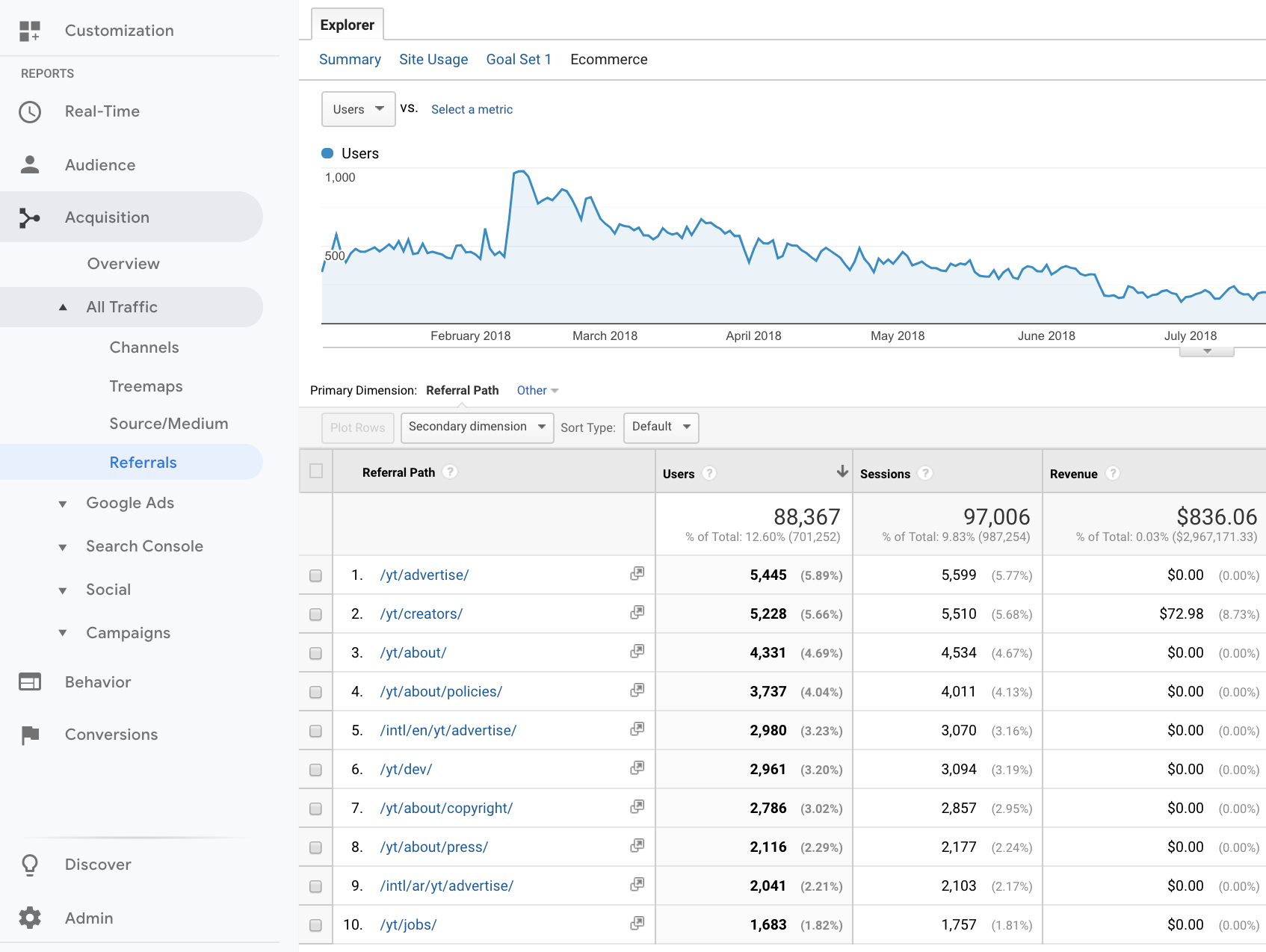
Under the category Traffic Sources within Google Analytics, you will be able to select Referrals. This allows Google Analytics see where users come from and present that information to you by tracking referral paths.
Referral paths are namely the journey that led visitors to your site. This path will first list the domain nameA domain name is the address of a website and is a necessary part of the process of establishing a web presence. of the site or source where the visitor originated. By clicking into the referring domain Google Analytics tab, you can then see which specific pages or linksHyperlinks, also known as links, are the connection points on a webpage that take you to other webpages. led the visitor to click on your content or site.
Some of the time, these referral paths may not glean anything significant, but there is also the possibility to learn a great deal about where your referral traffic is coming from.
UTM parameters placed on URLs are great sources of information for understanding exactly where your traffic is coming from. However, tracking this data is only possible when you have placed the UTM and URL yourself.
What referral traffic does is offer more than what a UTM parameter can in terms of links that are out of your control.
For example, if your referral data reveals that somebody else’s social media post — such as an influencer on Instagram — included a link to your content, which then drove a high number of referral traffic, this is a link which you yourself did not place, or attach a UTM to. Without analyzing this referral data within Google Analytics, you would not have known that your website traffic arrived due to an influencer’s social media post.
Therefore, monitoring referral traffic can be very helpful for key insights using full referrer Google Analytics information.
A lot of referral traffic will be a result of social media specifically, simply because these are prime information-sharing platforms, and places to easily share links and encourage clicks. As Google Analytics track referral links, you can then track all the social media-specific information to see which posts are promoting your content. This could be a tweet by one of your followers, a Facebook post or a tagged image.
Of course, referral traffic can also occur due to marketing efforts you have made yourself: namely, through guest posting on external sites. Your business is providing the valuable content and using a post or blog to promote your business, but having it appear on an external authoritative site means that the site is the reason for your referral traffic.
Guest posts in particular are very effective when it comes to tracking referral traffic, because you can analyze the data to see which parts of your blog post or content drove the most traffic, and therefore tailor your keywords for the most active traffic.
Referral traffic doesn’t always have to originate from dedicated posts or blogs, however. There are other simple ways which can promote referrals for your business, such as a comment on a blog, a post in a forum, a social media comment or a question posted online.
Use Google Analytics to better track your referral traffic and gain valuable insights into your business.

AI has become part of how people research and look for products, as well as…

If you’ve ever tested your website using Google PageSpeed Insights, you’ve probably been met with…



Budgeting for SEO is a terrifying prospect. There are so many elements in play, and seemingly endless considerations, rendering it…

Towards the end of September, on the 24th, Google released the second spam update in…

The amount you invest in your link building budget should be based on the realistic…

Search engines aren't the only automated systems accessing, interpreting, and making sense of content found…

There's plenty of scope when creating SEO campaigns. Each industry that turns to experts for…

PR has long supported brands in building authority and spreading awareness, but PR distribution has…

SEO can be complicated. It’s constantly changing and is not a one-and-done job. That’s something…

Google announced it was rolling out a further spam update on August 18, 2026. It…

Growing an SEO agency takes a lot of hard work. You've got to keep up…
Fill out the contact form or give us a call for a free consultation to determine the right digital marketing solutions for the growth of your business.

The team will usually respond within 1 hour.