How to Prepare Your Site for AI Agents
Search engines aren’t the only automated systems accessing, interpreting, and making sense of content found…


How people search and compare products online has changed. Just a few years ago, a quick Google search would give you all the information you needed to make a decision. Now, Google’s AI Overviews and LLMs like ChatGPT and Perplexity are on the scene. People no longer need to scroll through reams of results and read various articles and reviews before deciding. Instead, they can be led by the recommendations that AI Overviews and LLMs give. If your eCommerce brand isn’t visible to LLMs for relevant searches, then you’ll miss out on visibility and potential sales.
Visibility in AI and LLM search is one of the main ways that eCommerce SEO is changing. Yes, traditional rankings are still important, but with the shift in shopper search behaviour, you need to make sure that your brand and products can appear in AI Overviews and ChatGPT responses.
To do this, you need to make sure that your eCommerce website content clearly explains what you sell, who your products are for, what makes them different, and why customers should trust you. You also need well-structured category pages, product descriptions, helpful buying guides, and reviews to help AI tools connect your brand with the relevant search intent. Not sure how? Our guide tells you everything eCommerce brands need to know to get their products recommended in LLM search.
For eCommerce brands, LLM visibility is about making sure your products, category pages, and brand can be understood and recommended by large language models and AI-powered search platforms like AI Overviews. It’s not enough to have your products indexed by search engines. If your pages lack detail, context, or supporting content like buying guides or reviews, LLMs won’t surface your products.
As part of the buyer journey, people tend to ask LLMs for advice and recommendations rather than an explicit list of potential products.
Queries that look like this are common:
To answer these types of queries, LLMs need to understand the product type, the customer problem, why someone would be looking for a particular product, and why one brand or product might be better than the other. Your eCommerce SEO approach to your content needs to support different stages of the journey from discovery, education, and AI interpretation.
In short, AI search responses can influence customers long before they even land on your product pages. Potential customers use AI tools to shortlist brands, compare products, and to understand what they need to buy for a specific purpose. SEO for online retailers is broader because of this, as you need to build brand and product awareness early in the customer journey.
Instead of just ranking for product keywords like “fake tan for sensitive skin,” “fake tan,” “easy to apply fake tan,” or “best fake tan,” you need to be visible for the broader intent search terms we mentioned earlier. This is a crucial aspect of ChatGPT eCommerce SEO because if your brand isn’t visible at early-stage searches, then your competitors might be, shaping buyer decisions when you aren’t even present. Your content needs to be useful, specific, and trustworthy so users and AI search systems can understand why you’re relevant.
Read more in our Ultimate Guide to Ecommerce SEO.
How LLMs influence eCommerce rankings all depends on the signals they receive from your website and the wider internet. AI and LLMs need to see a clear relationship between your products, categories, use cases, customer needs, and brand authority.
Going back to our fake tan example, if you’re a beauty retailer selling fake tan products, you need to make it clear which products are suited to different skin types, and provide clear information on application and aftercare.
To create a full picture of your brand or product, LLMs will use a range of information to build their understanding, provided the information is consistent across the board.
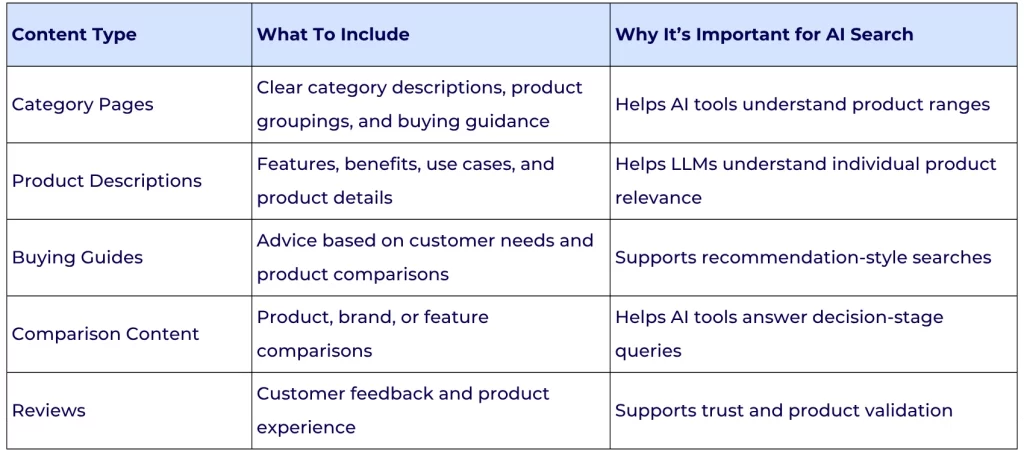
We created this handy table so you can understand where each type of content fits, helping LLMs better understand your products and build brand authority.
It’s not just content that helps LLMs understand your brand, categories, and products. Implementing technical schema markup across your pages can help give AI models further context and help them interpret product details. We recommend adding structured data for products, reviews, and offers.
We’ve created this helpful eCommerce SEO handbook to help you learn how to increase your search visibility so customers choose you. It’s free to download!
Your category pages help AI tools and site visitors understand your product range. They show how your products are grouped, the choices customers have, and the important buying factors for each category.
The best practices for optimising category pages for your online store all revolve around having helpful content. Your category pages shouldn’t only contain generic writing that is purely for SEO purposes. Instead, you need to make sure it clearly answers these questions:
Going back to our fake tan example, a suitable category page might explain the differences between gradual and instant tans, discuss skin-friendly ingredients and suitability for different skin types, and link to guides on application or aftercare. This helps AI tools connect your category page to searches like “what are the best gradual tans for sensitive skin.”
Product descriptions are an important aspect of product page SEO for LLMs. They help AI tools understand your individual products and their purposes. It can be tempting to keep your descriptions short or even duplicate them across your website for similar items. However, this should be avoided as it gives LLMs little to no context.
Good product description writing clearly describes what the product is, who it’s for, and why it’s useful. A solid product description should also include key features, specifications, materials, ingredients, sizing, benefits, and care instructions where relevant. It can also be helpful to include answers to common questions here, too.
Doing this strengthens SEO for eCommerce product pages by giving AI search engines the information they need to connect your products to relevant user queries and provide product recommendations. If you’re stuck on how to make your product descriptions work for LLMs, then our product description writing services can help you build the visibility you need.
Buying guides and comparison content help AI visibility because they answer a lot of questions that shoppers have when they are researching products to buy. Having informative guides and comparison content can make product recommendations better because it helps AI explain why one option might be better for someone than another.
In eCommerce SEO, a buying guide piece of content might explain how to choose the right fake tan, foundation, skincare routine, black-tie dress, car, holiday destination, saucepan set, football boots, or anything else. They’re helpful for LLM visibility because they help AI models understand what goes into buying criteria.
Comparison content helps AI tools explain why one option might be better for a search user than another. This type of content helps users and AI models to understand the differences between various options. For example, a piece comparing gradual tans vs. instant tans can help both AI systems and potential customers understand the differences and make the right decision for them.
If you want LLMs to recommend your products to users, you’ll need to look closely at your product pages, category pages, and your wider content strategy. Gone are the days of brief, duplicate product descriptions. Now, your product descriptions and category pages need to be unique and provide all the information users and AI machines need to make a decision.
If you’re unsure how to revamp your retail website content, then our eCommerce SEO agency is here to help you gain real visibility across LLMs and traditional search. All of our wider AI SEO services for eCommerce brands are made fully bespoke to your unique company for maximum results.

Search engines aren’t the only automated systems accessing, interpreting, and making sense of content found…

PR has long supported brands in building authority and spreading awareness, but PR distribution has…

The amount you invest in your link building budget should be based on the realistic…
Search engines aren't the only automated systems accessing, interpreting, and making sense of content found…

There's plenty of scope when creating SEO campaigns. Each industry that turns to experts for…
PR has long supported brands in building authority and spreading awareness, but PR distribution has…

SEO can be complicated. It’s constantly changing and is not a one-and-done job. That’s something…

Google announced it was rolling out a further spam update on August 18, 2026. It…

Growing an SEO agency takes a lot of hard work. You've got to keep up…

AI has become part of how people research and look for products, as well as…
Fill out the contact form or give us a call for a free consultation to determine the right digital marketing solutions for the growth of your business.

The team will usually respond within 1 hour.