
How Can Brands Compete in ChatGPT Without Paying for Ads?
AI has become part of how people research and look for products, as well as…


Do you want to increase organic trafficOrganic search traffic (sometimes called natural or unpaid search) is the traffic that's driven to a website because of unpaid placement on a search engine results page. to your site and get on that highly coveted first page of Google?
If yes, then you need to learn how to do a keywordKeywords are the words and phrases that potential customers might search for to find your business. search as well as how to research keyword competition and learn how to do it properly.
In terms of link buildingLink building is a process of acquiring links pointing to your website. These links are obtained by creating content, participating in social media or commenting on other blogs., keyword researchKeyword research helps websites unearth the best keywords to drive traffic and visibility. This research is supported by a number of powerful web-based tools, the best of which we’ve listed here. is crucial as it allows you to gain natural and organic linksOrganic links are the ones that you get from other websites. They happen when another website includes a link to your site with no restrictions in their content. that are looked upon favorably by Google and will have a greater impact on your rankings on SERPs in the long term.
Not sure how to carry out an effective keyword research report for your link building campaign?
Fear not, the below guide will provide you with step-by-step instructions that will ensure you are using the right keyword research methods for your business.
Before looking into the different keyword research types and how they can help your business to increase its visibly online, let’s first take a closer look at what keyword research is and why it is important for link building.
Keyword research is needed to find out what users are typing into the most popular search engines such as Google, Bing, and Yahoo. Without adequate keyword research, your business will be effectively invisible to users online.
Think about it this way. Do you want to waste both your time and money creating amazing content that nobody can find, or even worse, that nobody wants to read?
This is where the beauty of keyword research comes into play.
If you have never carried out keyword research before, this can be a challenging first step, but it is crucial if you want to achieve detailed keyword research.
Start by thinking about what a user would type into Google if they were looking for your product or service. You can then search these topics or phrases on online platforms such as Google, You Tube, and Facebook to see what other suggestions come up.
You can also use the Google AdWords Keyword Tool which can help you with keyword search volume and competition.
Once you have a list of seed keywords, it is now time to analyze these words or phrases using a range of SEO tools.
Although you may think that Google’s ultimate goal in life is to make the process of SEO more difficult for you, they do in fact provide several free online tools that offer keyword research best practices for your business. These include:
There are also a number of other online SEO tools that offer a free trial such as Ahrefs Keyword Generator and SEMrush Keyword Overview Tool. Although, you will need to pay if you want to use these on a regular basis.
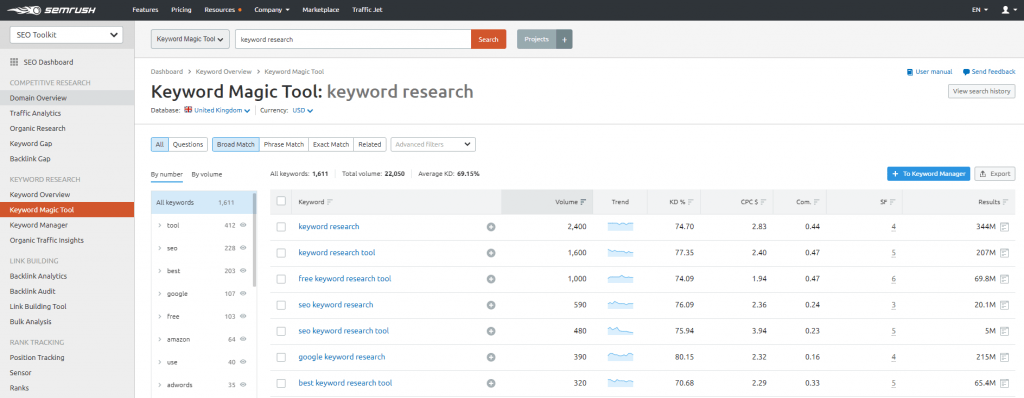
When it comes to selecting your final keywords for your link building campaign, there are several factors that you need to take into consideration.
This refers to the volume or number of searches for a particular keyword in a given timeframe. Keyword search volume is important because if no one is searching for your keyword, how can you expect anyone to find your content?
In terms of effective link building, you want to try and find that perfect keyword that has a relatively high volume while still having relatively low competition. It can also be a good idea to look for high volume keywords with top competitors that have lower domain authority and backlinks.
If your site is already on the first page of Google but you would like it to go up a rank or two, and the keywords have good search volume, focus your efforts on getting those specific keywords to move up.
Search intent, also known as user intent, refers to the purpose of an online search, i.e. the reason why a user is performing a particular search. Search intent is crucial for SEO and effective link building, as Google will rank your site higher if your page is the best fit for a specific search query.
If you are a commercial site, you will want to focus on keywords with transactional and commercial intent, whereas if your website is informational, such as a blogging site, you should opt for keywords with informational intent.
That said, it is worth noting that Google do favor informational content over promotional content, so you should also ensure that your page offers real value to your target audience.
Do you need help with keyword research? Get in touch with our SEO experts today!

AI has become part of how people research and look for products, as well as…

If you’ve ever tested your website using Google PageSpeed Insights, you’ve probably been met with…

Seasonality can have a huge effect on the success of your business. It is imperative to have a strong digital marketing campaign during periods of high consumer demand.

Without the correct tactics, your website doesn’t have a chance of appearing prominently on search engine results pages. Because if…

Towards the end of September, on the 24th, Google released the second spam update in…

The amount you invest in your link building budget should be based on the realistic…

Search engines aren't the only automated systems accessing, interpreting, and making sense of content found…

There's plenty of scope when creating SEO campaigns. Each industry that turns to experts for…

PR has long supported brands in building authority and spreading awareness, but PR distribution has…

SEO can be complicated. It’s constantly changing and is not a one-and-done job. That’s something…

Google announced it was rolling out a further spam update on August 18, 2026. It…

Growing an SEO agency takes a lot of hard work. You've got to keep up…
Fill out the contact form or give us a call for a free consultation to determine the right digital marketing solutions for the growth of your business.

The team will usually respond within 1 hour.