
Google’s AI Overview: Everything You Need to Know in 2025
AI search is a hot topic, and it’s also confusing. There’s a lot of tools…


While Google Analytics gives us a wide range of information about our website, you sometimes have to dig a little deeper to understand why people search for specific terms. You may think that Google is just a bunch of algorithms. However, it can actually tell you a lot of things about the behavior of your audience.
Here we look at Google Analytics’ behavioral data collection and why it is a valuable tool for your business.
On a superficial level, the behavior is based on a range of factors that lead someone to search for a particular term on search engines. Many aspects affect this search, including the use of causal language such as if someone searched for a shop ‘near me.’
Factors that affect search behavior include:
Each of the above elements contributes to the way Google brings up the most relevant search results.
Looking a little more in-depth at the above, you can use user behavior on Google Analytics to identify a range of metrics and helpful information.
Search intent is the reason why someone searches on search engines. There are typically three types of search intent:
This type of search is when someone is looking for something specific, such as a particular brand like Facebook or Nike, for example.
Suppose someone is looking specifically to complete a purchase or find a business they are interested in buying something from. In that case, this is called a transactional search.
If a search is a general question, then this stimulates informational results. This could be on trivial topics such as ‘how many Die Hard films are there’ or more in-depth research results.
You’ll then want to identify whether these visitors came through from organic sources. This is where Google Analytics can assist.
Some people feel that since Google Analytics changed the search queries results to a secure search, otherwise known as saying ‘not provided’ in your dashboard, that it can’t really help identify organic trafficOrganic search traffic (sometimes called natural or unpaid search) is the traffic that's driven to a website because of unpaid placement on a search engine results page. sources. However, there are still some insights that prove helpful for determining user behavior.
If you head to the dashboard > Acquisition > Overview, you then see Organic Search in the list of results.
When you click into Organic Search, it provides the keywords that people came through to your site on. You’ll see a mix of search intent here, and you can match this up to get a better idea of how visitors find you.
Using search intent can leverage ways to improve your website. By discovering how people search for your company, you can meet their search intent through content marketing or paid advertising.
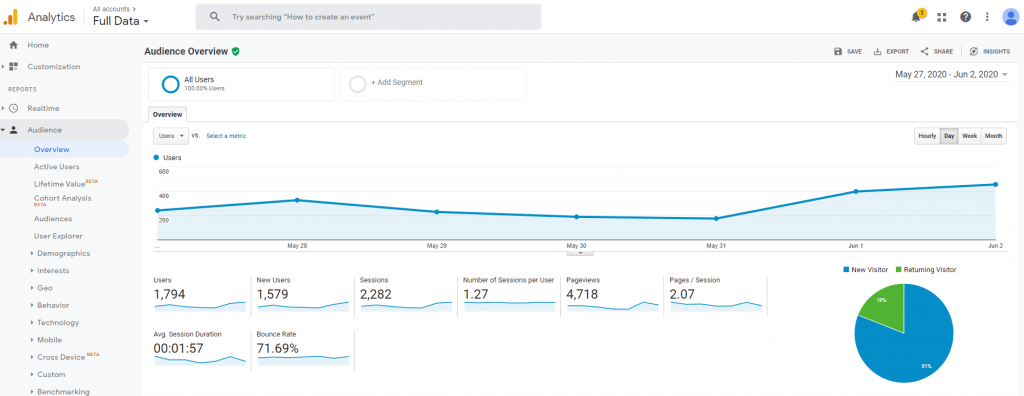
While two people of different ages may search for the same thing on Google, their demographic information will determine the results that show up. While search intent is said to be about a lot more than demographics, they are still an important metric.
The type of language they use to search for items is also identified by Google to bring the best results for their query.
To look at this metric, head to Google Analytics > Audience > Overview.
This will give you information, such as age, gender, location, device, etc. From this, you can develop buyer personas. Buyer personas are example visitors that fit your demographics, and it’s natural for a company to have several examples of your typical buyer. By creating these examples, you can tailor your marketing strategy to speak directly to these people. It will identify what type of search intent they use and can improve the information and language used to suit the purpose.
While determining the location of your customers can assist in targeted marketing, knowing the language people speak can also delve deeper into consumer searches. Some states in the US have high populations of Spanish speakers, so if you are targeting these areas, using native languages can help convert. It’s not just a simple as using Google Translate, as there are often different meanings for words in other languages. However, exploring the target audience will ensure you develop a strategy that is suited to your visitor needs.

AI search is a hot topic, and it’s also confusing. There’s a lot of tools…

First, there was ChatGPT, where you could ask a question and get an answer. Next,…

Selecting an SEO agency is an important decision for any business. Check out our guide on how to choose an SEO agency successfully!

Are you struggling to think about what to write about for your content marketing efforts? It’s not an uncommon situation–particularly…

There’s a good chance that you’ve already heard of PPC. As a marketing tool, PPC is invaluable, but there seems…

Towards the end of September, on the 24th, Google released the second spam update in…

The amount you invest in your link building budget should be based on the realistic…

Search engines aren't the only automated systems accessing, interpreting, and making sense of content found…

There's plenty of scope when creating SEO campaigns. Each industry that turns to experts for…

PR has long supported brands in building authority and spreading awareness, but PR distribution has…

SEO can be complicated. It’s constantly changing and is not a one-and-done job. That’s something…

Google announced it was rolling out a further spam update on August 18, 2026. It…

Growing an SEO agency takes a lot of hard work. You've got to keep up…
Fill out the contact form or give us a call for a free consultation to determine the right digital marketing solutions for the growth of your business.

The team will usually respond within 1 hour.