
How Can Brands Compete in ChatGPT Without Paying for Ads?
AI has become part of how people research and look for products, as well as…


Creating a new website for a brand or business is not something that happens overnight and certainly isn’t something that can be rushed. Many different things need to be considered before you even draft your initial design, such as working out your theme, pages that need to be included, fonts, and a whole lot more.
One such thing that needs to be done early, preferably before you launch your website, is to create a robust XML sitemapA site map is a list of pages on your site and their relative importance. Use sitemaps to make it easier for visitors to find what they're looking for, and to ensure that search engines can find all the information they need.. An XML sitemap is just one of the many on-page SEO techniques you can implement to help boost your website’s ranking on search engines such as Google. Unlike many advanced SEO practices, this isn’t too difficult to do and can be completed within twenty minutes.
Without trying to sound condescending, a sitemap is exactly what it sounds like it is: a map of your website. In its simplest form, an XML sitemap is just a list of all the URLs that make up your domain and how they link together. It efficiently maps out how the website is structure, which is important for SEO.
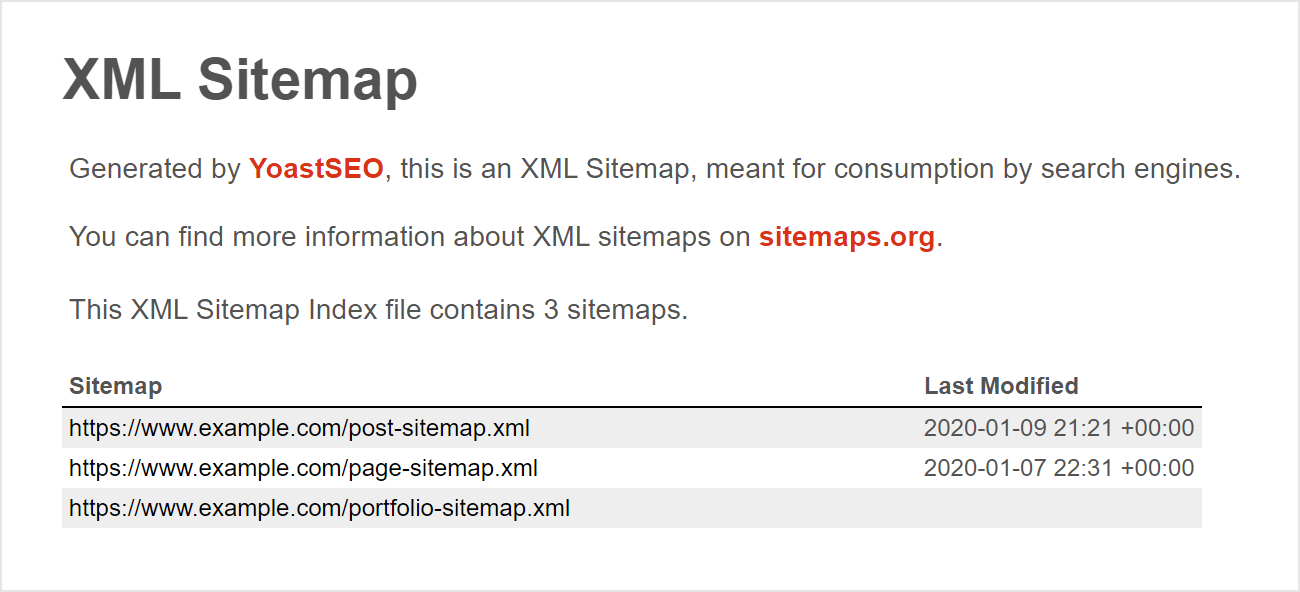
It’s important to know that an XML sitemap is not for the benefit of a user but is instead meant to be implemented to help Google better understand your website. All search engines, especially the big ones like Google and Bing, use crawlers to go through websites and gather the information stored on indexes. It’s these indexes that help Google better understand where your website should rank and on what specific keywords. If Google can’t understand your website, then you’re going to rank poorly.
This is the main purpose of an XML sitemap. It gives crawlers an easy way to see what’s on your website, effectively working as a table of contents. Creating a good XML sitemap can instantly improve your ranking, so it’s definitely something that is worth doing.
Furthermore, a good sitemap can do other things too. As well as aiding with indexing, these maps can also display updates to a page as well as the importance a page has on a website, which can be very helpful in proving that your website is not using duplicate contentDuplicate content is content that appears more than once across a single website. Duplicate content can be a sign of poor resource management, low trust, or a lack of quality control..
There are many ways to create a sitemap, such as using various plugins like Yoast for websites built on WordPress, but the industry de facto way of creating one is through using software called Screaming Frog.
This software is free to use and can be used to make sitemaps of websites that have up to 500 pages, and it doesn’t have to be a website that you own. It means you can create a sitemap of your competitors to see what they’re doing well and not so well, which can influence your approach.
To create an XML sitemap on Screaming Frog, once you’ve downloaded the software, all you need to do is the following:
From here, you then need to upload this file to your website via FTP. Unfortunately, there’s no universal way to do this, as every website development software and CMS is different, so it’s worth checking with a developer to see what’s best for you. However, having your sitemap on your website isn’t the end, as there’s still a vital step that needs to be taken: submitting the XML sitemap to Google.
In order to do this, you need to have Google Search Console connected to your website. To learn how to do this and other important SEO techniques, check out our Intelligence Hub. Once it’s connected, go to the search console and select your website. From the dashboard, you then need to click ‘sitemap.’ This will lead you to a page where you can add a new sitemap, and from here, you simply need to enter the URL that it was saved on. It should end in .xml as it’s an XML file.
Once that’s done, your XML sitemap should be all set, ready to go, and improve your SEO rankings. If done correctly, you should see improvements in your performance, and when used in conjunction with other SEO tactics, your website has more potential to be noticed and seen in the right SERPs.


AI has become part of how people research and look for products, as well as…

If you’ve ever tested your website using Google PageSpeed Insights, you’ve probably been met with…

Towards the end of September, on the 24th, Google released the second spam update in…

The amount you invest in your link building budget should be based on the realistic…

Search engines aren't the only automated systems accessing, interpreting, and making sense of content found…

There's plenty of scope when creating SEO campaigns. Each industry that turns to experts for…

PR has long supported brands in building authority and spreading awareness, but PR distribution has…

SEO can be complicated. It’s constantly changing and is not a one-and-done job. That’s something…

Google announced it was rolling out a further spam update on August 18, 2026. It…

Growing an SEO agency takes a lot of hard work. You've got to keep up…
Fill out the contact form or give us a call for a free consultation to determine the right digital marketing solutions for the growth of your business.

The team will usually respond within 1 hour.