
Insight into the Google September 2026 Spam Update: What It Means for You
Towards the end of September, on the 24th, Google released the second spam update in…


It is understandable to feel frustrated if your site fails to reach the first page of Google, especially if you have invested considerable time, money, and effort into your on-page SEO efforts.
If you’re struggling to make it past the second or third page, there is a good chance the user experience is impacting your presence in the search engine results pages (SERPs).
If you’re ready to catapult your landing pages up the search engines, you must focus on the Google Page Experience. However, you might be wondering what it is or why it matters. Continue reading to find out more.
The Google Page Experience relates to the new set of metrics used to measure your site’s user experience and speed, which Google coined Core Web Vitals in May 2020. It is fundamental to its core algorithm update, as the metrics are used to judge the page experience before ranking.
Google strives to provide its users with the best on-page experiences time and again, and factors bounce rateBounce rate is the percentage of visitors to a website who visit only one page. A high bounce rate indicates that visitors are not satisfied with your website., click-through rate, and dwell time into its ranking factors. For instance, if a visitor quickly clicks away from your site, it indicates they were unhappy with the page experience, reducing your ranking in the SERPs.
Any webmaster eager to improve their Google ranking, brand awareness, and web traffic must provide a good page experience.
Currently, three main sets of metrics make up Google vitals and measure your site’s user experience. The search engine uses the metrics to provide a user-friendly platform, harmonising with other ranking factors, such as HTTPS security, a safe browsing experience, and mobile responsiveness.
Here are the three main Google vitals you mustn’t overlook:
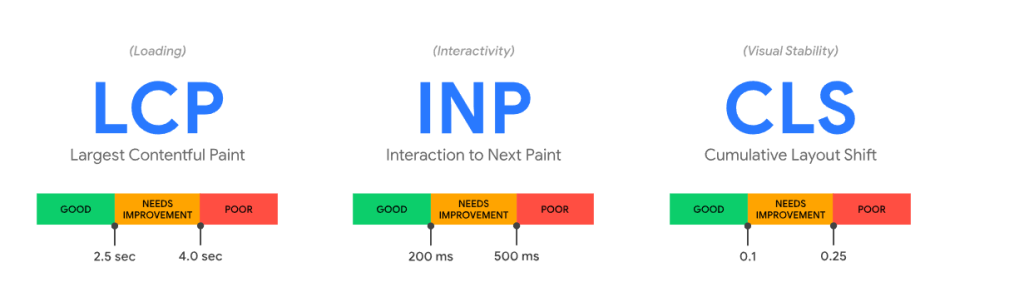
The CLS metric will measure the stability of your website assets. For instance, it will identify the percentage of the screen impacted by movement, such as images or text jumping around the screen as a webpage loads. For example, some adverts may push text or images further down the page, negatively impacting the user experience.
The LCP metric tells Google how long a web page’s largest content element takes to load until a user can fully view and interact with it. It shapes how fast a site loads, as the largest asset tends to be the last element in view. It’s a major Google Vitals ranking factor you mustn’t overlook or underestimate.
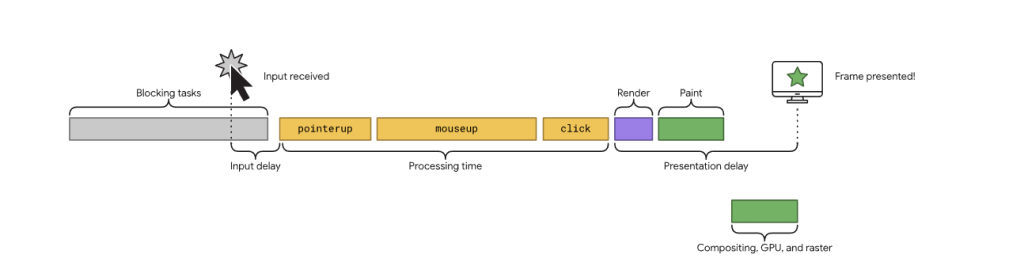
The INP metric will analyse how long it takes for a user to interact with a web page and the response from the site. It’s all about interface responsiveness, with the user getting a visual response on the page after clicking, tapping, pressing a key, etc. It’s a very all-around, comprehensive metric.
The above metrics aren’t designed to overcomplicate SEO strategies. They’ve been introduced to prevent poor user experiences each day. As an internet user, you likely understand the frustration of hitting the wrong button because an ad loads suddenly on a landing page, which is what Google is trying to avoid.
Incorporating Google Core Web Vitals into your strategy will lower a site’s bounce rate, increase its ranking in the SERPs, and improve its user experience to drive engagement and sales.
In addition to the three main metrics mentioned above, there are additional Google Page Experience ranking signals you’d be foolish to overlook. For instance, you must pass Google’s mobile-friendly test to boost your mobile ranking in the search engine. Also, HTTPS is part of the search engine’s Core update, meaning sites with the HTTPS protocol will rank higher, as they’ll protect users from hacking.
Also, you must ensure your site is free from intrusive interstitials, as it shapes content accessibility. For instance, you may receive a Google penalty if your site has poor pop-ups or plugins that don’t meet interstitial design guidelines.
Your goal should be to create a high-quality, speedy, and mobile-friendly website to turn visitors into customers, improve its Google page ranking, and increase its online reach. To do so, you must focus on developing a responsive, user-friendly website.
Carefully consider all elements that will determine your site’s user experience, such as:
Make it your mission to improve your site’s accessibility, value, credibility, speed, and reliability to provide a good user experience day after day.
We understand the process of altering your site for a better Google Page Experience may feel overwhelming. We can simplify the process at Click Intelligence with our Core Web Vitals Tools Checker, which is easy to use.
It couldn’t be easier to get started. You must enter your domain URL into the checker before clicking the ‘Ask Google Page Insights API’ button. Once you have done so, you’ll receive helpful advice on how to improve your score.
Also, we can help you identify where your site is going right or wrong by scoring it in the following five categories:
Analysing the scores is simple, as they are presented out of 100. Scores of 90 and above are deemed excellent, 50-89 are okay, and 50 and under require immediate attention.
If you’re unsure how or where to start when improving the Google Page Experience, don’t hesitate to call or email the friendly, experienced team at Click Intelligence. We proudly provide many SEO services to help you enjoy success online, such as SEO consultancy, content marketing, technical SEO audits, link building services, and SEO management.

Towards the end of September, on the 24th, Google released the second spam update in…

If you’ve ever tested your website using Google PageSpeed Insights, you’ve probably been met with…

Without the correct tactics, your website doesn’t have a chance of appearing prominently on search engine results pages. Because if…
Google's Core Web Vitals reports how a page performs, and here's our checklist to improving page experience this 2022!
Towards the end of September, on the 24th, Google released the second spam update in…

The amount you invest in your link building budget should be based on the realistic…

Search engines aren't the only automated systems accessing, interpreting, and making sense of content found…

There's plenty of scope when creating SEO campaigns. Each industry that turns to experts for…

PR has long supported brands in building authority and spreading awareness, but PR distribution has…

SEO can be complicated. It’s constantly changing and is not a one-and-done job. That’s something…

Google announced it was rolling out a further spam update on August 18, 2026. It…

Growing an SEO agency takes a lot of hard work. You've got to keep up…
Fill out the contact form or give us a call for a free consultation to determine the right digital marketing solutions for the growth of your business.

The team will usually respond within 1 hour.